

the nutcracker problem: part 1
“chinese tea,” “arabian coffee,” and loving ballet when it doesn’t love you back

TABLE OF CONTENTS
“The Nutcracker Problem: Part 1”
Surprise: Your Cherished Holiday Tradition is a Racist Fever Dream!
Not Just “Asian Hate”: The Consequences of Narrative Violence
Edward Said Would Hate This: A Short History of “Arabian Coffee”
“The Nutcracker Problem: Part 2” (coming soon!)
The lobby just before The Nutcracker has a distinct smell, no matter where I am. San Jose to DC, Philadelphia to Chicago: The scent of hot chocolate and crushed velvet can always be found in the 30 minutes before showtime. That smell reminds me, no matter the age on my driver’s license, that I can always find holiday cheer and my love for ballet. I can always find it at my annual visit to The Nutcracker.
Like many washed-up ballerinas, Nutcracker season has a melancholy feel for me. I’ve been eight different roles in the production: a relatively small number for someone with two decades of ballet training under her belt. Regardless, I was just as enamored with my 10-year-old role of Ginger Snap as I was with my 19-year-old role in Flowers corps, or my 21-year-old rendition of Arabian lead. I don’t dance in The Nutcracker anymore—I stopped doing ballet for a few years, which I wrote about here—but you’ll still find me in the audience. I smell Christmas spirit in the concession line, and even just the strings in the Overture can bring me to tears. (I think it’s the “what-if” that makes me emotional: the “that was me, once.” But I digress.)
If Nutcracker is my annual assurance that I don’t forget my past at the barre, then it’s also my yearly litmus test for who’s joining the world of ballet. The audience and the dancers and the programs vary city to city, but that Nutcracker scent typically draws newbie and longtime ballet patrons alike. The Nutcracker is the moneymaker, to be frank, for ballet companies; it’s a holiday show designed for children. After all, the man who first staged the production in the United States claimed in 1944, “It will go on for as long as there are children.”1 If kids and their families aren’t in theater seats in December, then they sure as hell can’t be counted on for a ballet company’s Carmen, Coppelia, or Jewels run come spring. In other words, who’s at The Nutcracker tells me who’s investing in the art of ballet. In my experience, these numbers dwindle each year.
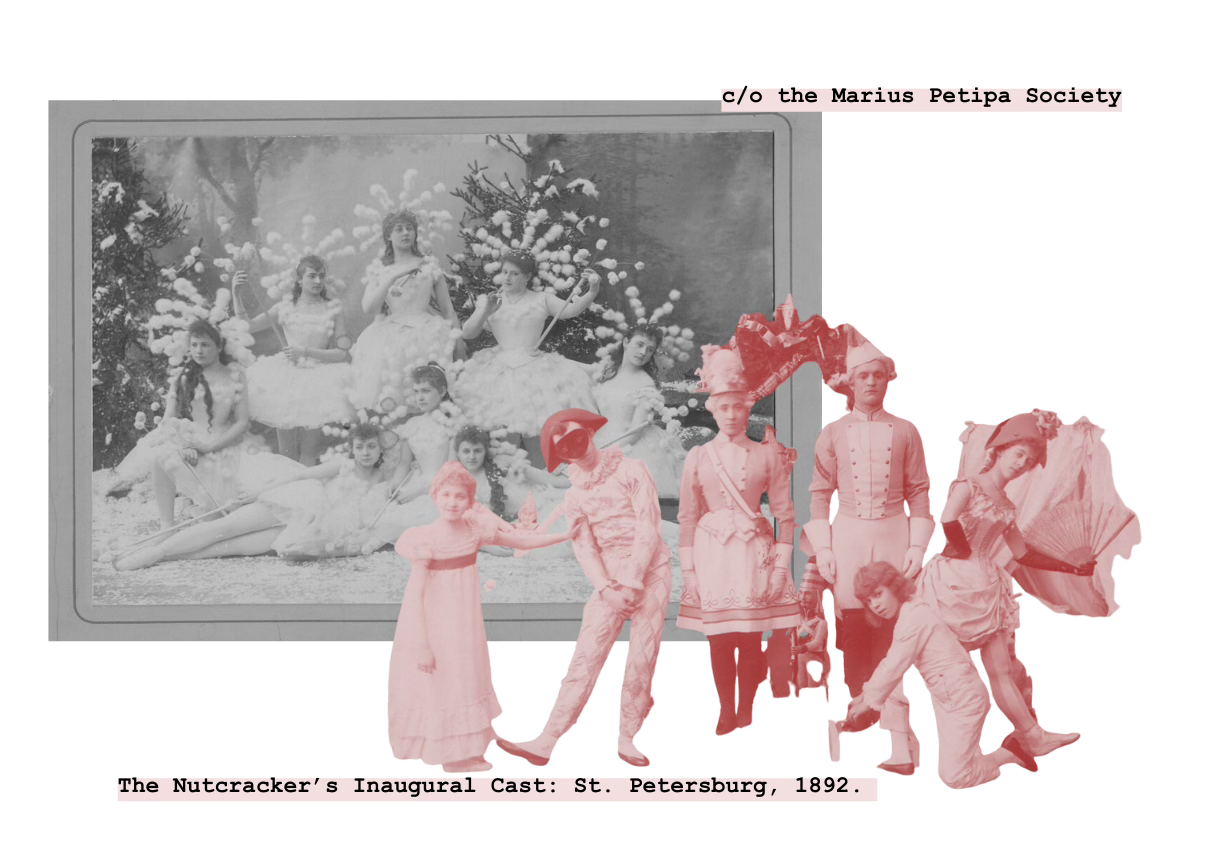
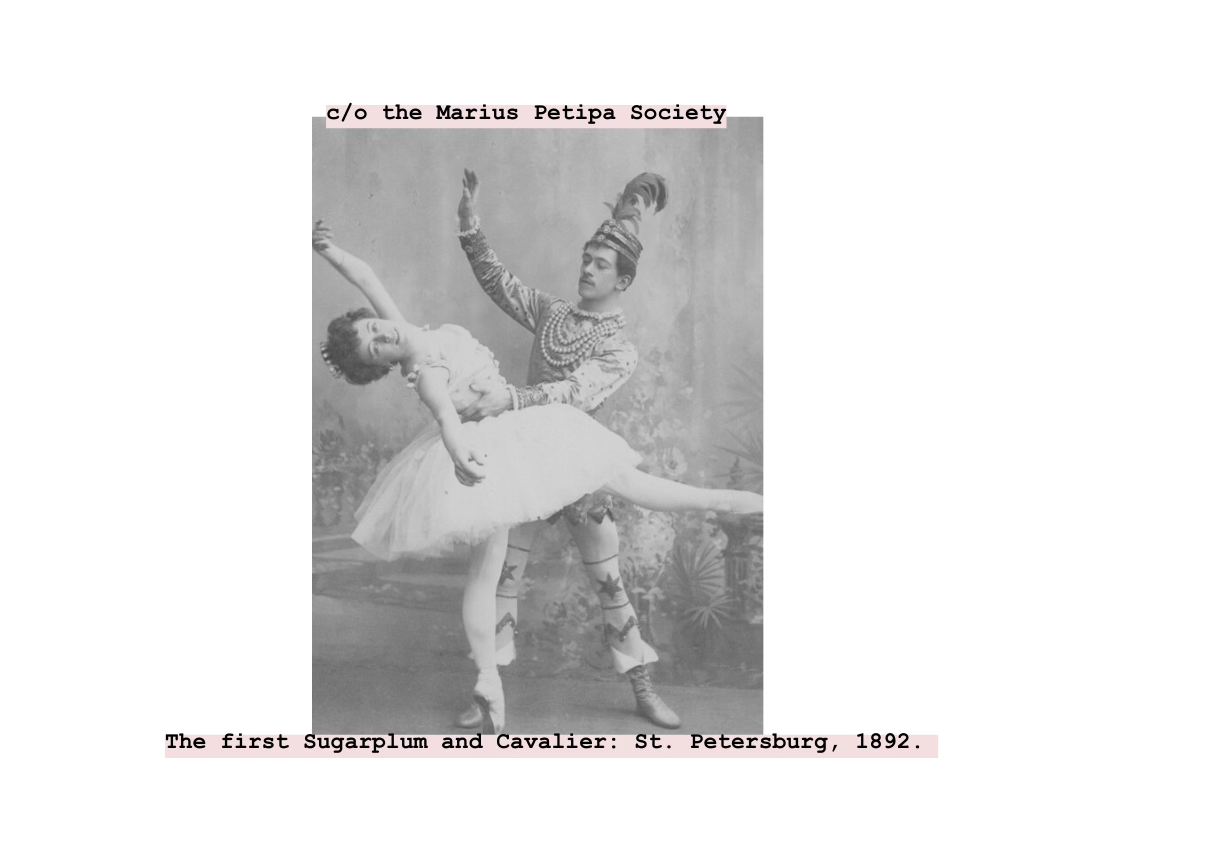
Let’s start with the obvious: The Nutcracker is old. The original production was choreographed by French-Russian choreographer Marius Petipa in 1892, and set to Russian composer Pyotr Ilyich Tchaikovsky’s (iconic) score. It debuted in St. Petersburg, Russia, then was revived in 1944 San Francisco by William Christiensen, then revitalized by George Balanchine’s popular rendition in 1954 New York City. The latter is the most common version performed today, and is what most American audiences think of when they think of Nutcracker. That is to say: Common Nutcracker choreography and norms are, at least, 72 years old.
If ballet has become this loved-from-afar septuagenarian, then the deprioritization of The Nutcracker can be accounted for from multiple directions. The loss of ballet audiences can be, too. There is a lack of access, first off, to performances with a base ticket cost of $50.00. Even with promotions like student, senior, and military discounts, a family of four can expect to shell out over $200 for an annual trip to The Nutcracker (not including tax and concessions once there). Reduced interest in The Nutcracker and ballets like it could also be due to a loss of cultural relevance. In fast-paced, algorithmic 2026, the 100-year-old story of Von-Trapp adjacents Clara and Fritz feels distant, if not dusty. Furthermore, there just isn’t the cultural reverence for ballet as an art form that there was 75 or 50 years ago. Ballet is no longer the soft power it was in the Bolshoi and Balanchine eras, and mainstream dance content is typically used to sell something or stop your scroll. This, along with growing anti-intellectualism and anti-humanities sentiment, easily prevents audiences from seeing a ballet just for kicks.
I’d also be remiss not to mention the Trump Administration’s defunding of the National Endowment of the Arts (NEA). This devastating decision has dented ballet companies’ ability to invest in their dancers and choreographers, resulting in a funding vacuum which only hurts ballet’s ability to keep annual traditions competitive—even alive. This becomes a vicious cycle: ballet companies end up begging for empty pockets...from a public unmotivated to shell out.
The Nutcracker is losing audiences due to a myriad of factors—these impact not only this production, but all of ballet, dance, and the arts. Some of this relevance loss is outside the ballet world’s control. Forces like late-stage capitalism, a hostile government, and the deprioritization of classical dance are things ballet companies must weather to stay alive. But amid this environment for artists, there is a path ballet companies could take to expand their influence in 2026: Update classic productions like The Nutcracker.
Surprise: Your Cherished Holiday Tradition is a Racist Fever Dream!
A refresh to the 1892 production is far from simple, but it’s been a growing conversation in the ballet world for years. Desire for change centers around a few pieces in the Second Act, which consists of a series of divertissements where Clara, the main teen role, explores “The Land of Sweets.” In the Land of Sweets, Clara and her Nutcracker enjoy Chocolate in Spain, Coffee in “Arabia,” Tea in China, Marzipan in France, and Peppermint Candycane in Russia.2 As you’d probably expect for a European art form with origins in royal French courts, the representations of all non-European cultures in The Nutcracker have typically been very, very racist.
This year, I brought a group of my friends with me to see The Nutcracker in Chicago, and let them in on my annual tradition. Knowing my audience of mixed Middle Eastern and Latino baddies, I let the people know ahead of time: “It gets racist in the second act.” And sure enough, once the first violin chords of Arabian were played, my friends and I locked in sarcastic eye contact. The dancer was beautiful, she had fantastic technique, and she was very flexible. But what she performed was not anywhere near to what an Arab or “Middle Eastern” dance could be. Instead, the choregrapher instructed this white woman in her bra and harem pants—and her white partner in his pseudo-fez—to emulate sex onstage. And we paid to watch!
We discussed this moment as we exited the theater, ranking each piece in the divertissements. Everyone agreed that Arabian was a standout piece—yes, for its skill, but mostly for its sexualization. I was left to consider: Would my friends feel comfortable returning to a ballet audience after watching The Nutcracker? This should be the essential question that ballet companies ask themselves, too.
For an annual show like The Nutcracker—a lucrative production which serves as the gateway to the ballet world—the global moments within the divertissements serve as a representation of these cultures. Given the show’s primary audience of children and families, these pieces also serve as a moment of education on these cultures to the young people in the audience. But when these representations are inaccurate, disrespectful, or outright racist, The Nutcracker enacts narrative violence while actively shrinking its audience base. When East, West, and South Asian children attend their first Nutcracker with their families, is it the way these dances are choreographed, costumed, and framed which keep them from coming back? If that’s the case, audience loss might not be a total issue of access or interest. Instead, it could be the problem of Orientalism.3
In the 134 years since The Nutcracker’s debut, audiences have changed. The country has changed—so has the world. The way we tell this story needs to change, too. If ballet companies want more of the public to return to ballet, they must listen to the discomfort of the dancers casted in these roles. After all, it’s that feeling that drove two dancers, among others, to work to change the ballet where they both got their start.
To better understand why The Nutcracker’s divertissements need a refresh, I spoke with soloist Georgina Pazcoquin and principal dancer Tara Ghassemieh. I also spoke with the director of the documentary ABOUT FACE (2024), Jennifer Lin. I asked them about their histories with The Nutcracker, as well as how Orientalism within the divertissements impacts perceptions of Asian cultures in real life. We spoke extensively about how these representations impact ballet’s ability to remain relevant, and how much more ballet companies could be doing to accurately reflect their cultures to young audiences. What resulted is a three-part exploration of the past, present, and future of The Nutcracker, all through the expert eyes of the dancers behind your holiday tradition. From what they shared with me, I learned: From Coffee to Tea, from China to Iran to the Philippines, today’s dancers want to create a ballet world more reflective of our society. The question is: Will the companies they work for want that, too?
That process starts, according to Pazcoguin and Ghassemieh, with The Nutcracker.
Tapping an expert: Georgina Pazcoguin, Soloist
“It was never my intention to be such an outspoken artist, [or] a glass-breaker. I just wanted to dance.”
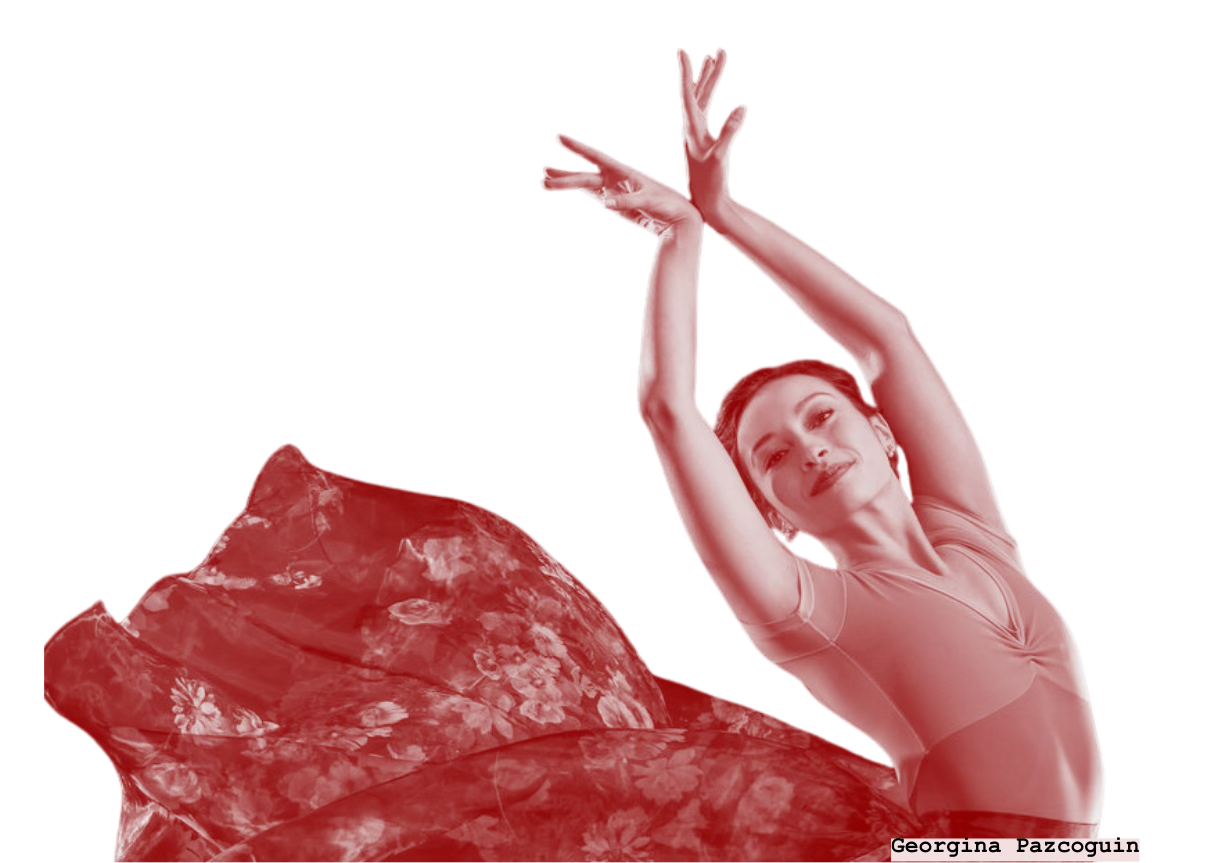
While Georgina Pazcoguin today fashions herself as “The Rogue Ballerina,” her origin story closely resembles my childhood, Barbie in the Nutcracker dreams. Raised in Altoona, Pennsylvania by her Filipino-Italian family, Pazcoguin trained in professional ballet since the age of four. She moved to New York City at 16 to attend the prestigious School of American Ballet, and was granted a company position in the New York City Ballet (NYCB)4 upon her graduation. She eventually became the first Asian-American woman to be promoted out of the corps of NYCB, making Pazcoguin’s role as a soloist a supposed model of representation and diversity for the company.
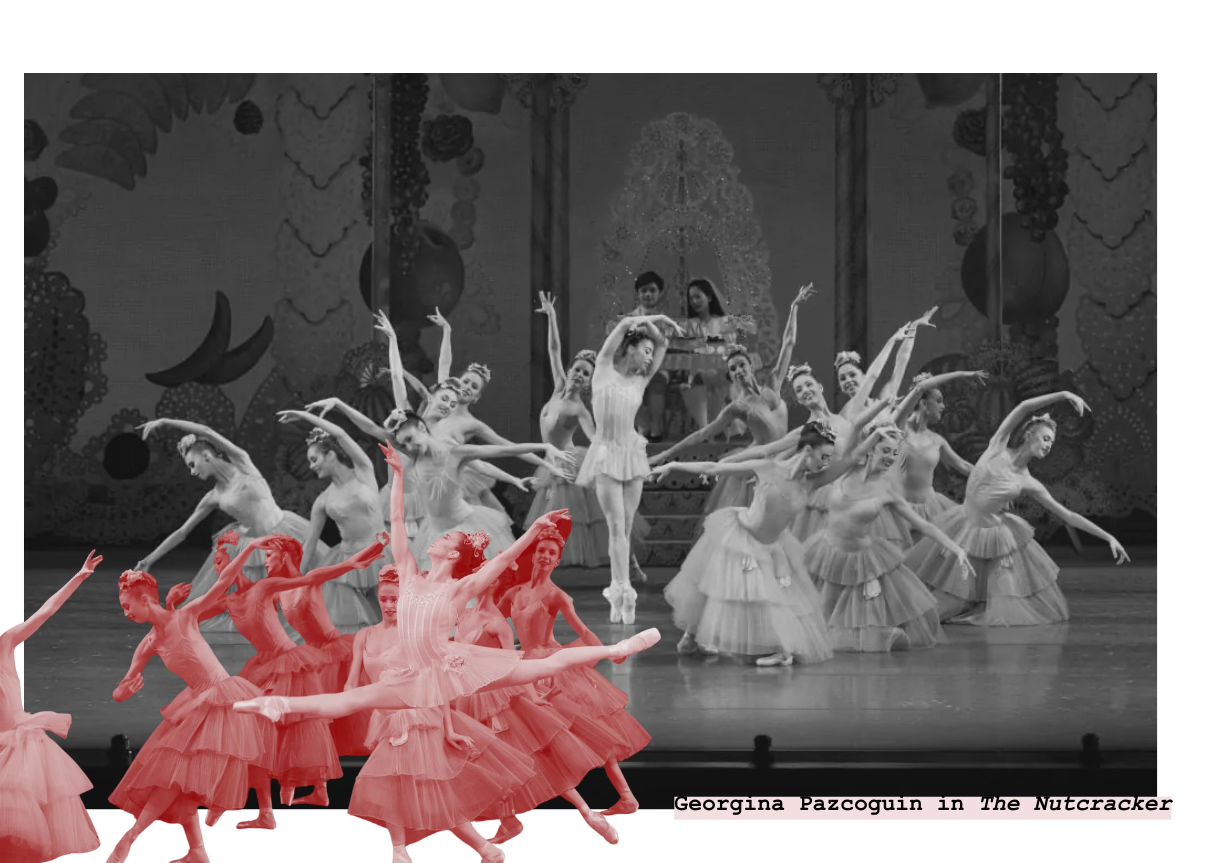
But rising through the ranks gave the biracial Pazcoguin a less positive perspective on her role in the art form: “The ballet world sees me as Other.” In Altoona, she more-or-less fit in. But when she moved to New York City and joined a major ballet company, Pazcoguin looked around the studio and realized: she was the only person who looked like her. That difference sparked a new understanding of the power dynamics in ballet. Per Pazcoguin, “it’s something you can’t unsee or can’t unlearn.”
This understanding deepened during Nutcracker season. Pazcoguin, unsurprisingly, was regularly cast in the Chinese Tea divertissement. This pattern began at her hometown ballet academy, but once in the world of the NYCB, the tension inside her grew. Though it was a featured role on a world-class stage—everything she once wanted—Pazcoguin couldn’t take Chinese Tea’s choreography, costuming, and character choices seriously.
“I had my epiphany moment on stage... because I had a geisha wig with a Chinese ceremonial gown, and then the man was stuffed in a tea box, and then you had the porcelain fingers,5” Pazcoguin told me, remembering her first time performing Balanchine’s Nutcracker. “It was so many things, [so many] different facets of Asianness—and it wasn’t even specific.” Despite her having a Filipino background, therefore being a woman of Asian descent, Pazcoguin felt forced to embody something she wasn’t. Something no Asian person could be, regardless of their country of origin: Chinese Tea was a wonky mishmash of East Asian cultures, made for a 19th-century, European audience. Pazcoguin was being forced into the narrative of Orientalism.
Not Just “Asian Hate”: The Consequences of Narrative Violence
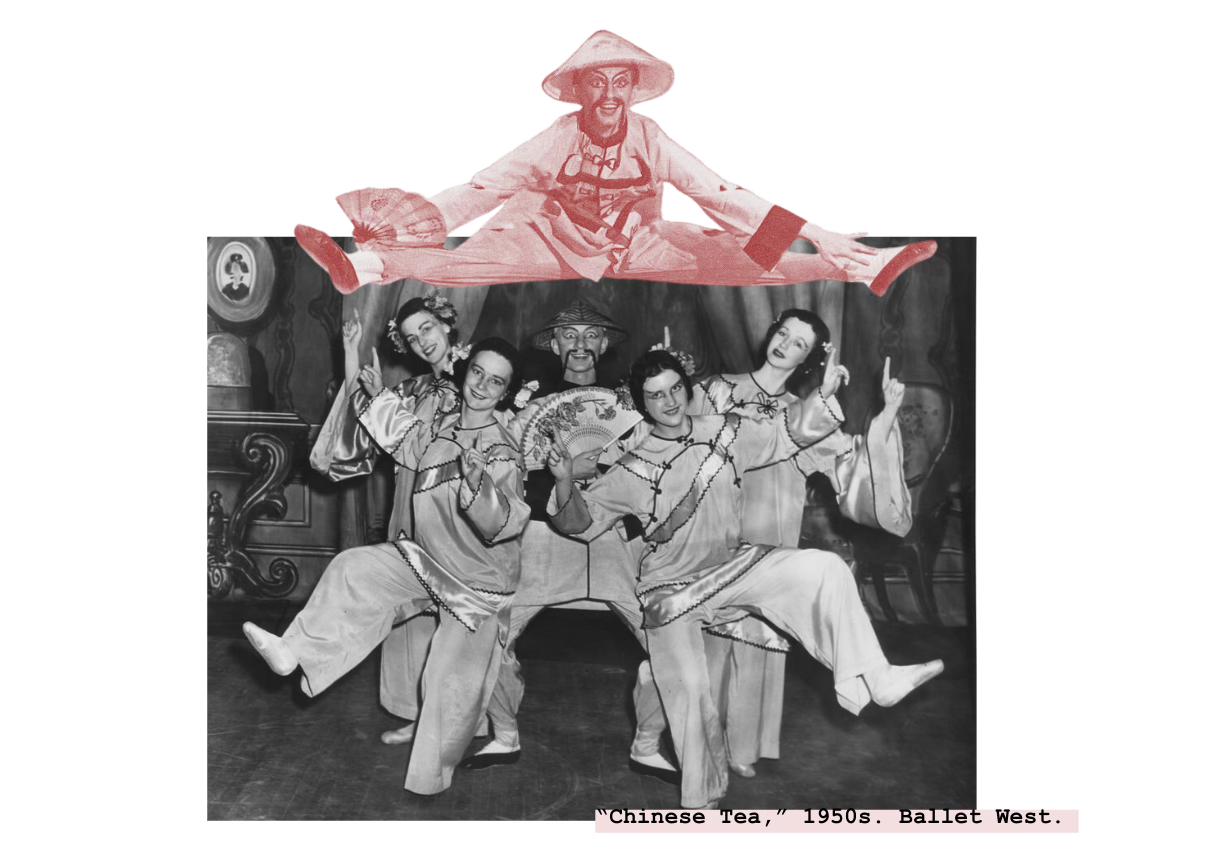
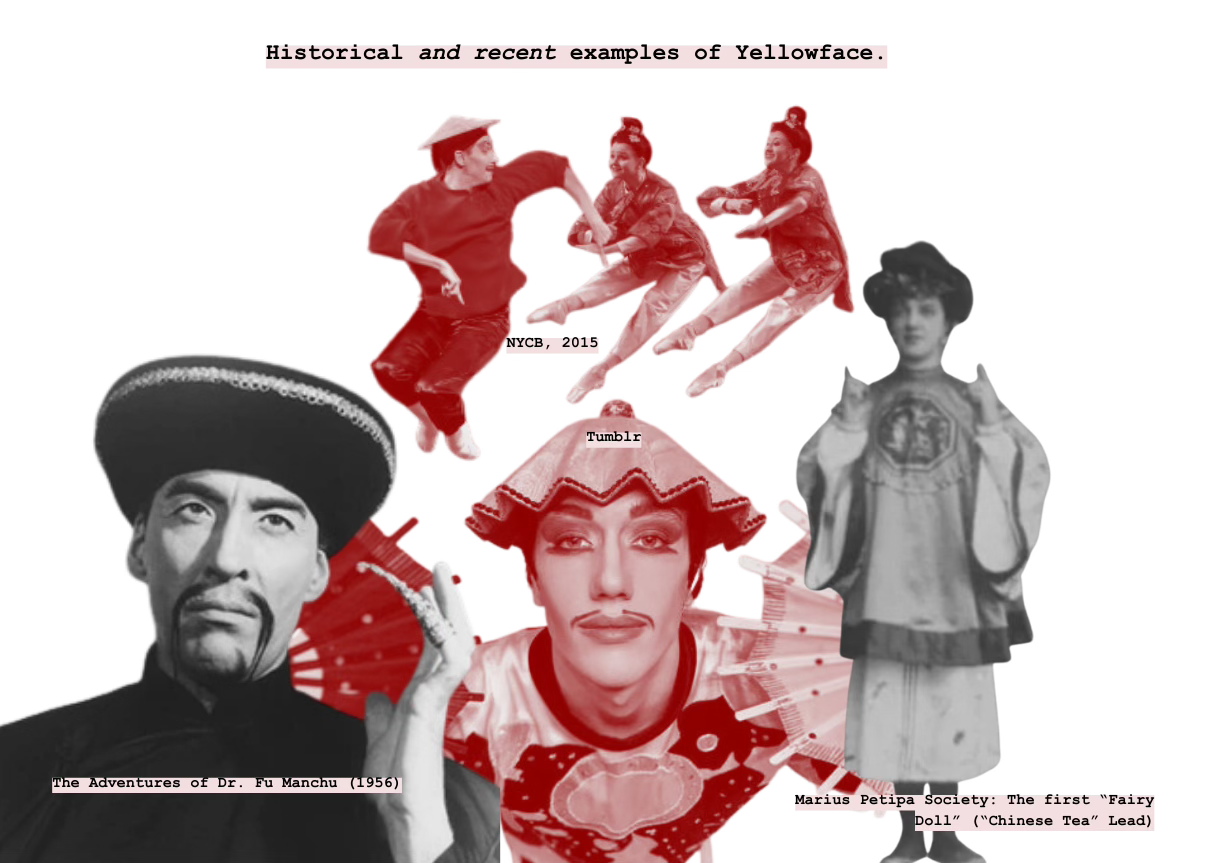
Her experience is one of many; Pazcoguin’s discomfort with the Chinese Tea divertissement is shared with generations’ worth of East Asian ballet dancers. Chinese Tea has long been an example of Yellowface, or the use of makeup to imitate East Asian features as part of a usually-offensive performance.
The term “Yellowface” is an adaptation of “Blackface;” both are forms of minstrelsy, and both have appeared throughout Western countries for centuries. The rise in Yellowface performances and characters—such as “John Chinaman,” “Dr. Fu Manchu,” and “Madama Butterfly”—can be traced to the 19th century: a period of increased immigration to Western countries from China and Japan. This time is known as the “Yellow Peril” Era: When East vs. West narratives and Orientalist tropes (like those we’ll discuss in Tea) were introduced to the public for the first time. This messaging spanned hemispheres. Yellowface was as prevalent in 1892 California as it was in 1892 St. Petersburg: the very year The Nutcracker debuted. Yellowface—and the xenophobic intentions behind it—was especially powerful when it was delivered in art and leisure activities: books, games, shows, ballets.
“Chinese Tea,” the one-minute piece in The Nutcracker’s divertissements, has this reputation because of specific staging and choreographic choices: Bobbing heads, “porcelain” or “chopstick” fingers6, parasol swirling, and a smiley, goofy air that’s not typical of classical ballet. Pazcoguin believes this to be a difference in status between the other pieces and the “Chinese” characters. “Every divertissement in Act II is supposed to be nobility,” she told me. “In the Balanchine version [...] [Chinese] were the only ones who shuffled out, did a little bow, and [had] no denotation of nobility. In fact, putting the lead male character in the rice patty hat...field workers wore the rice patty hat.” While the Russian, Spanish, and French dances commanded respect, Chinese Tea evoked laughter—at, not with.
ABOUT FACE Director Jennifer Lin felt similar to Pazcoguin, but from an audience perspective. As a dance mom, Lin (who is half Chinese) felt “bugged” during her daughter’s Nutcracker performances. “The Chinese dance, to me, just seems so goofy—almost insulting.”
Aside from choreographic choices, Tea’s hair and makeup make a caricature of Chinese features, keeping in the unfortunate tradition of Yellowface minstrelsy. Even Pazcoguin, being of Asian heritage, “put on Yellowface” to perform the Chinese divertissement. “For me, it was just accentuating the features that I had,” she said, mentioning exaggerated eyeliner and thick, false lashes. “But for [the] White dancers who were mostly doing the roles, it was really bad.” In reviewing historical images from Nutcracker productions past, the typical Yellowface makeup can include: extended or multi-winged eyeliner; thin, straight, ‘surprised’ eyebrows; pale or powdery foundation; saturated blush; deep red lipstick. The result is a clear departure from the norm of stage makeup: Natural tones, creating dimension, using well-spaced eyeliner to actually increase the size of one’s eyes from the stage.
Pazcoguin also brought up hairstyling as a major point of contention with Chinese Tea. “A Fu Manchu mustache...is wild,” shared Pazcoguin, referencing the long, drooping mustache style invented by British novelist Sax Rome. The style is named for Rome’s 1929 villain, Dr. Fu Manchu, which became a popular British serial. The “villainous” and “eccentric” imagery of the look was used often in Chinese caricatures in film and TV, and was prominent during the “Yellow Peril” Era across Western countries. The characteristics which fueled this era resulted in generations of pain for Asian Americans; the Chinese Exclusion Act, two World Wars, Japanese Internment, and more cause grave consequences for Chinese, Japanese, and other East Asian communities. Regardless of this well-documented history and its consequences, The Nutcracker held dear to the imagery of Yellowface for decades.
Styling men with a Fu Manchu mustache was, unfortunately, commonplace when Pazcoguin performed Nutcracker. “And then on top of that, using the queue [hairstyle], which was imposed at risk of death? It was like, wow. We just really did not think this through.” Pazcoguin referenced here an early, hometown performance of Chinese Tea, where she donned the fake hairpiece at her instructor’s encouragement. A symbol of submission to the Qing Dynasty, the queue was made mandatory for Han Chinese men between 1644 and 1911. As Pazcoguin said, refusal was punishable by death. To place this symbol on a young, Asian girl made little sense for The Nutcracker’s story, or for its relatively-young audience. But this style was the single, historical facet of Asianness Pazcoguin’s Nutcracker production chose to portray: dangerous, authoritarian, and lost to time.
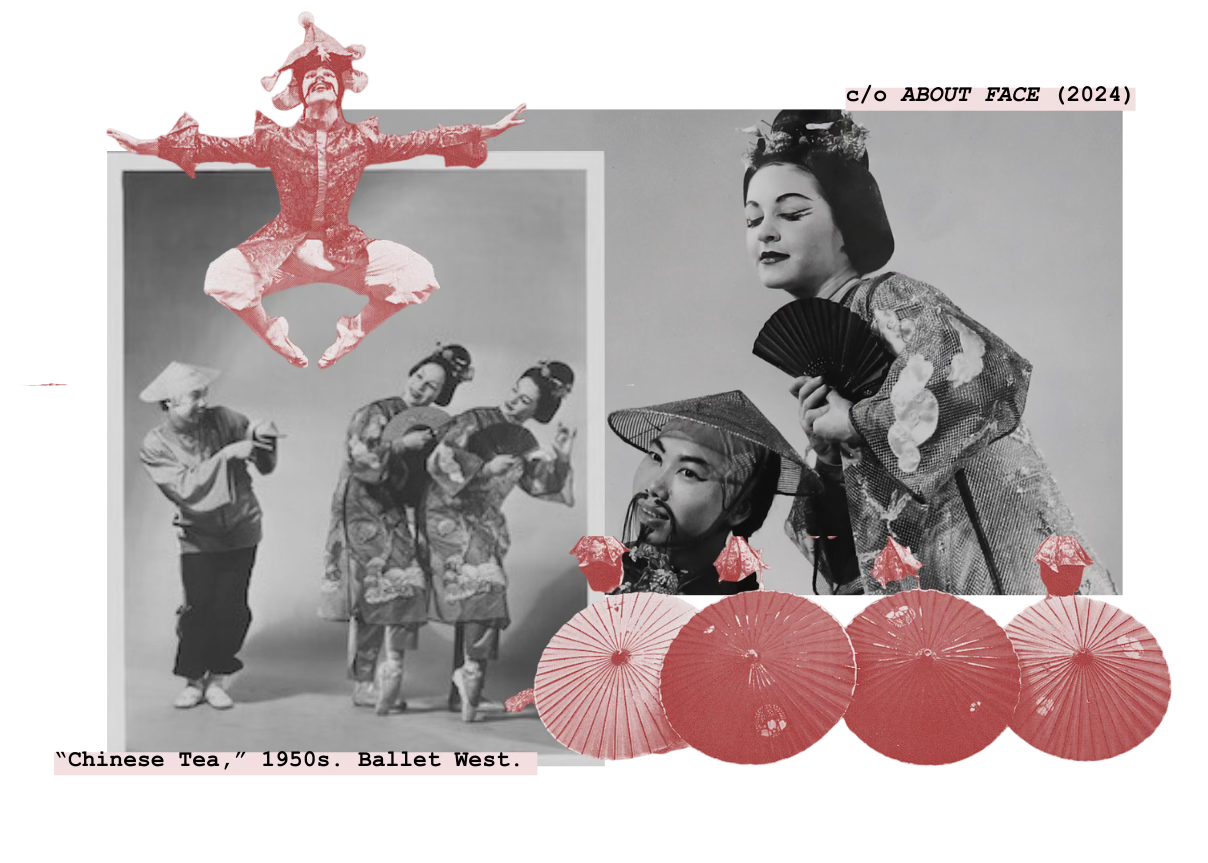
After years of performing “Chinese Tea,” Pazcoguin recognized that the various Asian cultures referenced in the divertissement were treated as relics. These experiences are what brought Georgina Pazcoguin to fight for more authentic representation onstage, starting in 2017; this led her to her partner-in-ballet-activism, Phil Chan. Chan is a respected choreographer and ballet dancer, and together, Pazcoguin and Chan head what’s known now as the “Final Bow for Yellowface” campaign. This effort combats Asian stereotypes in the ballet world, and works to connect companies, choreographers, and corps with resources to revitalize their productions. Their focus has, typically, been on Nutcracker, which was also the subject of Jennifer Lin’s ABOUT FACE.
“Every company is doing, like, a ch--ky Nutcracker with anti-Asian sentiment,” Chan stated in ABOUT FACE. At first, in 2017, there were several companies who didn’t wanted to hear what Chan or Pazcoguin might have to say about “Chinese Tea.” “One artistic director came back to me when I reached out about their Nutcracker and said, ‘Well, sorry. This is just how Chinese people looked at the time,’” Chan shared. (Dear Reader: This is not at all how Chinese people looked at the time.) The director continued, “‘That’s just history.’”
Despite repeated discussions on cultural sensitivity, DEI, and adapting to changing audiences, there was significant pushback from ballet companies to any changes to The Nutcracker. Narrative violence could be explained away as simply as that artistic director had: “It’s just history.” This kind of historical revisionism troubles activists like Chan and Pazcoguin, who understand deeply the danger of a single story. “When we have this cheap-shot stereotype that is the only representation of Asianness on our stages, over and over again, every year since we were little kids,” said Chan, “that reinforces a very specific idea of who Chinese people are.”
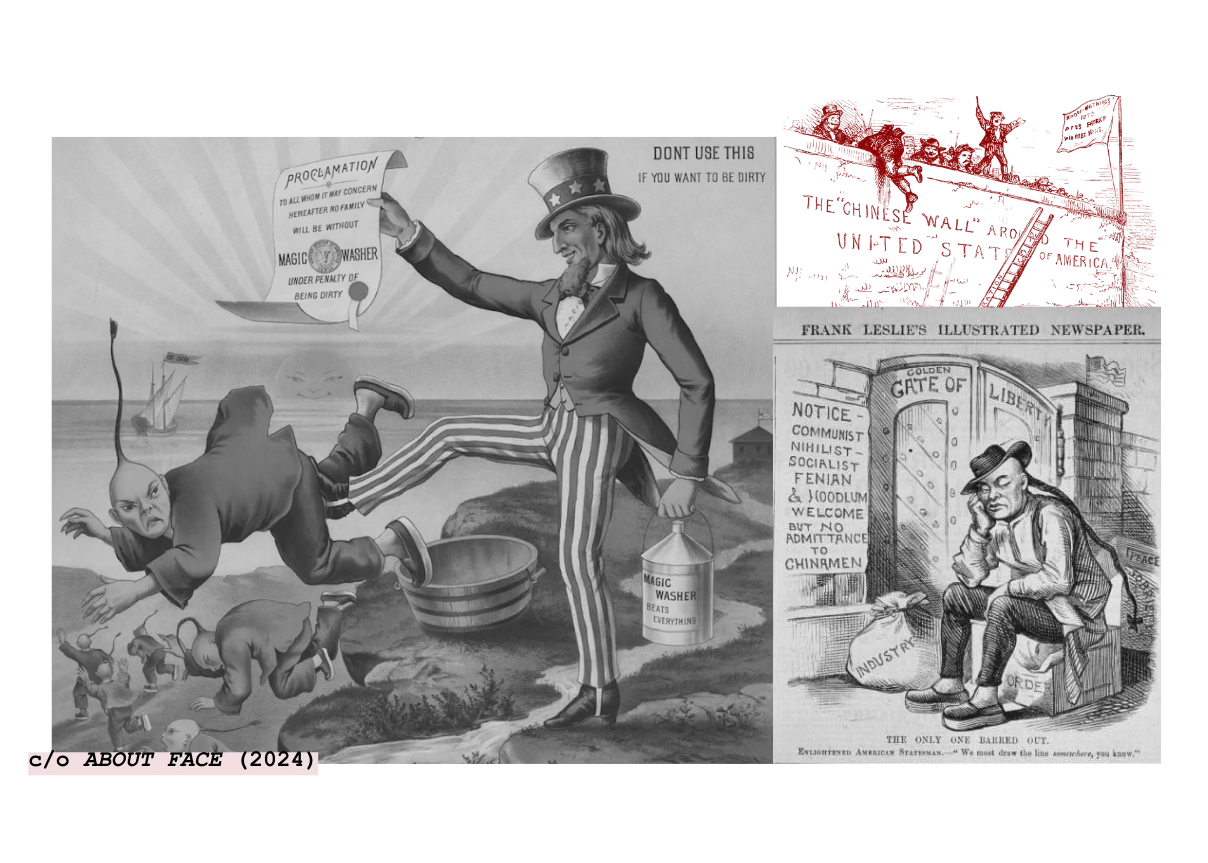
In the years since Chan and Pazcoguin have collaborated, the stakes of narrative violence like that in The Nutcracker have become clear. Beginning in 2019 and accelerating during the COVID-19 pandemic, East Asian communities in the United States have faced increased incidents of hate crimes, leading to harassment, targeting, assault, and murder. Thanks, in no small part, to sinophobic7 messaging from then-first-term President Trump, 9,000 anti-Asian hate incidents were reported from March 19, 2020 to June 31, 2021 in the United States. Rates of hate crimes toward Asian Americans soared, especially against elders and Chinatown residents in hubs like Oakland and San Francisco. In 2021, eight people were murdered in an Atlanta shooting of multiple spas and a massage parlor: six of them were Asian women. In 2022, Michelle Go and Christina Yuna Lee were both pushed into oncoming trains on the New York City Subway, sparking widespread fear for Asian Americans in the city. The #StopAsianHate campaign was not a flash in the pan—it was a coordinated response to a traumatic period for Asian Americans, and East Asians across the West.
These instances have been explained away by supremacist thinkers as a simple consequence of COVID-19’s origin country—but that’s only part of the picture. I’d instead posit, in the footsteps of many Asian American thinkers and activists, that this wave of “Asian Hate” is a newer version of 19th century “Yellow Peril” racism and xenophobia. The consequences of “hate” go beyond that very word: Murder. Rape. Abuse. Hate CRIMES. I’d wager its origins go deeper, too: centuries of Western imperialism, perhaps?
Regardless of how we frame the escalation in anti-Asian sentiment, it’s clear The Nutcracker’s imagery is fanning an old flame. There is real gravity to how we tell stories, and the content in the Chinese divertissement is no different. But knowing the weight of a narrative also demonstrates its possibility; perhaps the divertissement is also an opportunity for education and change. Were ballet companies to follow Pazcoguin and Chan into revising the Chinese divertissement—and, not to get too crazy, but Arabian too (more in one second)—The Nutcracker could function as more than a nod to 19th century, Russo-European fantasies and ideals. For the U.S. companies Pazcoguin and Chan work under, The Nutcracker could become a bastion of authentic representation, drawing upon the real-life dance history, styles, fashions, and customs of the cultures it features. If Nutcracker is the door to the ballet world, then perhaps it is revisions to the divertissements on which future success hinges.
The campaign against Yellowface in ballet began, of course, with Chinese Tea. But dancers of other backgrounds now look to Chan and Pazcoguin as a model to fight narrative violence in other parts of The Nutcracker. Following their near-decade of activism, a contemporary of theirs is trying to reimagine a different piece in the divertissements: Arabian.
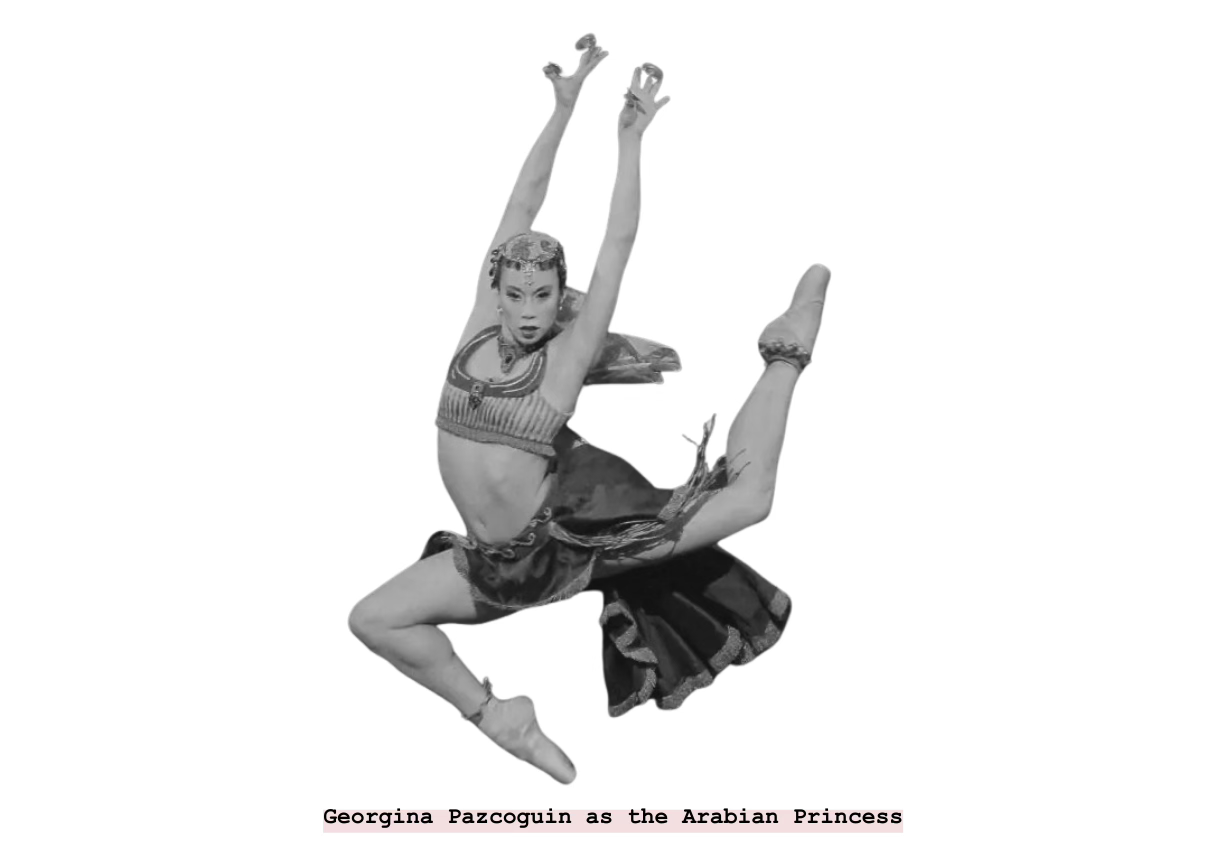
Tapping an expert: Tara Ghassemieh, Principal Dancer
“I’ve always very proudly been Iranian. Like, [as a] little girl, I was ‘Persian Swan’... my friends would call me that.”
Tara Ghassemieh told me this between bites of orange, calling in from her home in Irvine, California. I had followed her work for years; being Iranian American and a ballet dancer, her original production, The White Feather: An Iranian Ballet Tale, had caught my attention back in 2022. Ghassemieh is one of few Persian8 dancers in the ballet world, and has repeatedly spoken out about ballet—and dance generally—being illegal in the Islamic Republic of Iran (IRI). “The Iranian National Ballet was the biggest ballet company in the Middle East for 20 years,” she shared with me, allowing her red nails to lead her explanation. “[It was] just being established when the regime came in and eradicated it.”
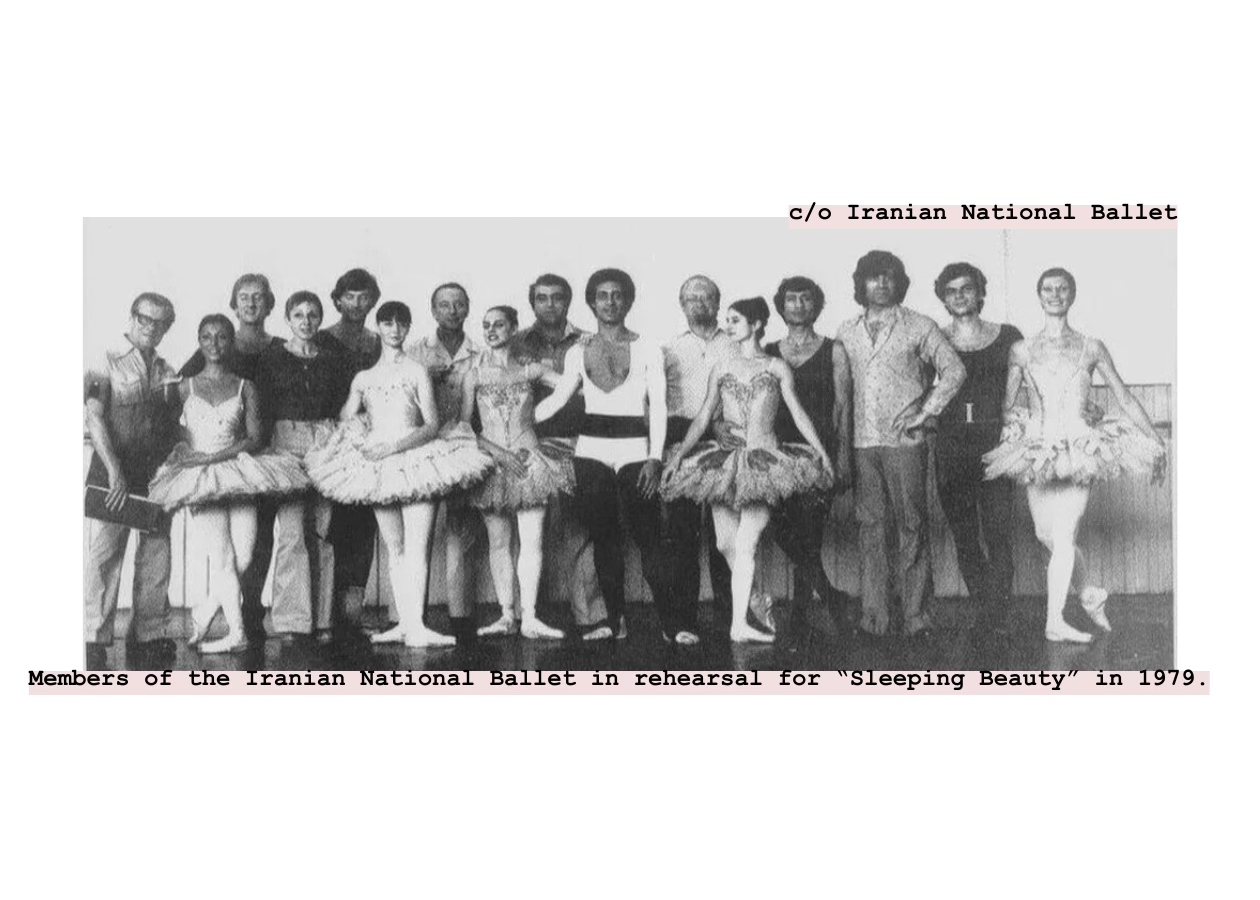
Like many diasporic Iranians, the 1979 Islamic Revolution sent Ghassemieh’s family from then-Iran to Southern California. Growing up between Persian and American culture, she found the dance studio to be a place of comfort and self-expression during a “tumultuous” childhood. Similar to Pazcoguin in her Pennsylvania hometown, Ghassemieh quickly demonstrated talent in ballet. She was invited at fifteen to move to New York City and train with the American Ballet Theater at their Jacqueline Kennedy Onassis School—a direct parallel to Pazcoguin’s time at NYCB. But just two weeks before moving, Ghassemieh would, tragically, break her back. Her big debut transformed into the first of multiple setbacks.
The next stages of her career were a fight to get back onstage. Following her injury, Ghassemieh managed to retrain herself back to ballet shape. But then, she unexpectedly became a young mom. Navigating new parenthood and adulthood, she then went through a divorce when her son was only one. Among legal proceedings and custody agreements, Ghassemieh somehow found time to retrain herself—again. Still, Ghassemieh struggled to find opportunities for ballet in Southern California, where there are no major professional companies. But she refused to allow her efforts to fail. Like many Iranians and recent immigrants, her entrepreneurial spirit brought her security and success. Ghassemieh is now an independent artist and the artistic director of her own company, IntuitV Artship. But this success did not result in rose-colored glasses about the ballet world: “Unfortunately, I am the first Iranian American principal ballerina,” she told me solemnly. “That is due to suppression.”
While political history and personal experience drives Ghassemieh to create further opportunities for dancers of shared backgrounds, she has a primarily spiritual connection to this mission. She told me of a vision9 she had when working with a channeler for the first time: “What appeared [...] was rows and rows and rows of women, covered in all black chador—not even hijab, like, chador10. And they’re pointing at you, and you are now spinning in a fire, like a Sufi dancer. And they’re pointing and they’re clapping...” While Ghassemieh was overcome, the channeler she worked with was clear: “She said, ‘You have to do something. They’re showing you on a stage in Iran. They’re showing me.’”
From there, a path was laid for the Persian Swan: “I dance for myself. Yes, but I’m dancing for them.”
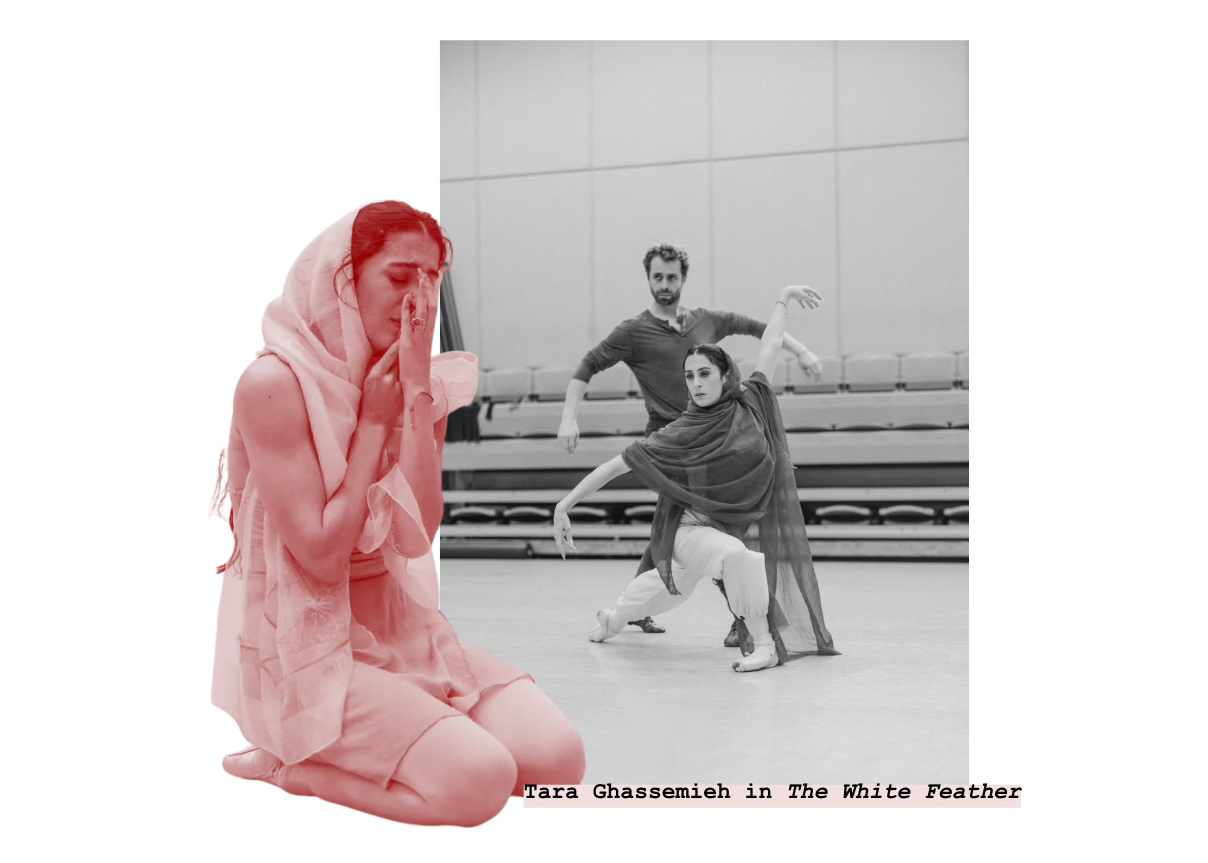
And they—being, the people of Iran—need a Ghassemieh in their corner. Since the 1979 Islamic Revolution, dancing has been a crime, punishable by fines, jail, and floggings. The fundamentalist regime sees the moving body as sinful, and women dancers as temptresses into a Western, haram11 way of life. But to dance in public has been an act of protest and bravery for decades: through the Green Movement, Girls of Enghelab, the murder of Jina “Mahsa” Amini, Woman Life Freedom, and now, the 2026 anti-regime protests, led by the working people of Iran.
If you want to scare the shit out of the Supreme Leader,12 they say dancing is the way to do it.

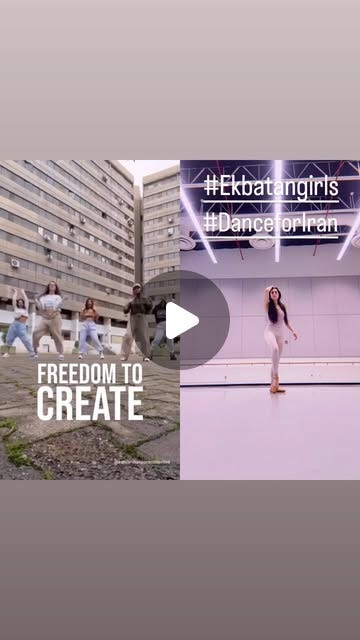
Protesters with dance backgrounds—or just a penchant for gher: the hip-swaying move typical on Iranian dancefloors13—are at great risk when sharing their art publicly. But because of Iranian culture’s deep-rooted love for dance, art, and poetry, protesters use them as tools to generate emotional affect and remind Iranians of who they are, beyond the regime. As Ghassemieh tells it, “[Iranians] dance as a part of Zoroastrianism, Sufism... We are the original artists of the planet. We’re the poets, we’re the writers. We created wine!”14 She knows dance to be part of our cultural DNA, but from both East and West, critics purposefully separate artistry, fluidity, and liberation from anything Iranian.
“Our history’s been erased, and we’ve been turned into barbarians,” said Ghassemieh.
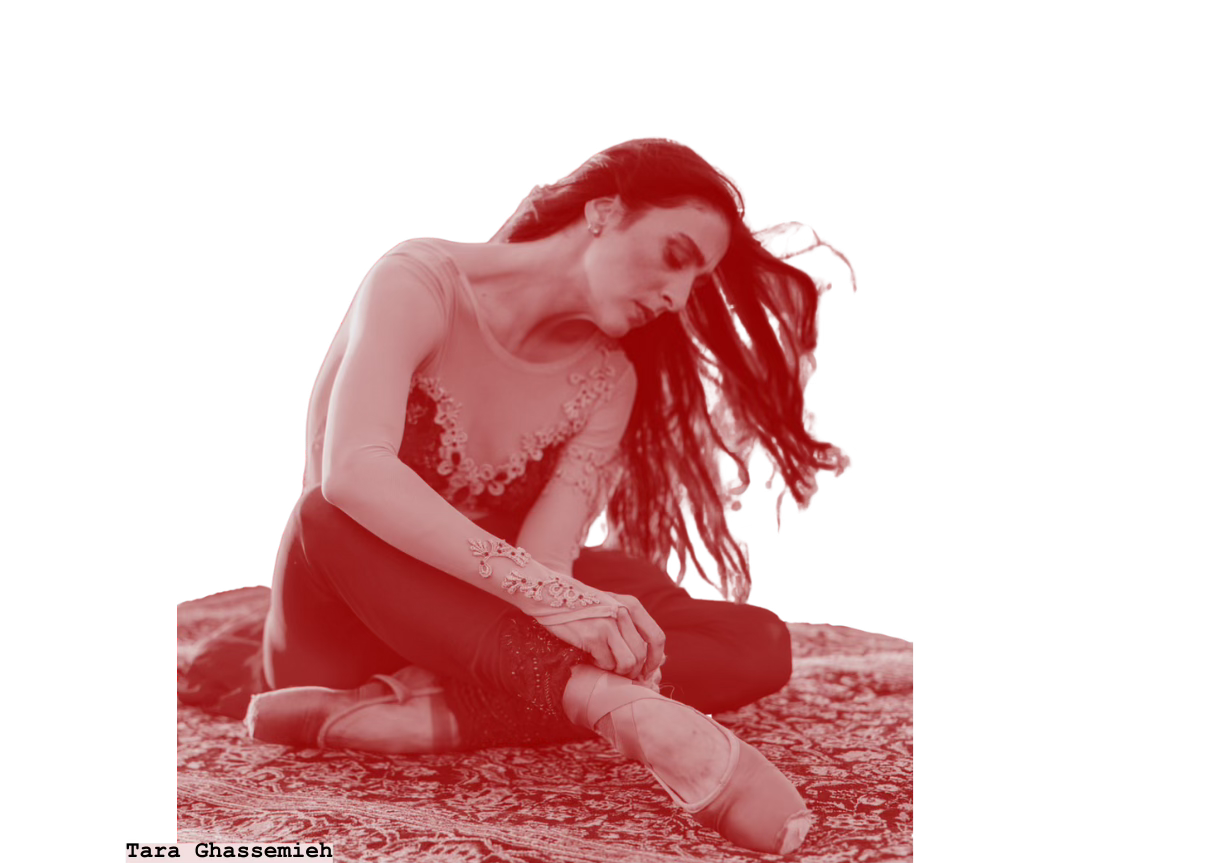
This rewriting plagues other Muslim-majority communities: from Somalis, to Lebanese, to Afghans, to Palestinians. This issue goes further than Iran, and far wider than Ghassemieh and I. The cultures from which humanity grew have now been reduced to “shitholes,” “backward,” “dangerous,” and worse, all thanks to generations of imperialism and exploitation. For those whose parents left their home countries and joined the diaspora, the only way to counter this narrative is with perfection. Financial and academic success, titles in front of names and degree acronyms preceding, and immaculate self-presentation are weapons against these stereotypes—that’s why you’ll find so many Iranian dentists. Ghassemieh knows the pressure children from these communities are under, and she worries that it further distances the diaspora from our dancing roots. “I have one Iranian student, I’m like, ‘Please never give up. Please don’t be a doctor, dentist... please! And if you become [one], that’s fine, but keep dancing.’”15
Through projects like The White Feather, Ghassemieh herself hopes to carve out more spaces for ballet dancers with South and West Asian heritage. “I hope to be this beacon,” she told me. “There is a place for us in ballet and in dance.” But despite Ghassemieh’s activism and choreography, roles for these dancers remain few and far between. And in the popular, more lucrative ballet productions like The Nutcracker, the “representation” offered to dancers of her background is one of self-exploitation and Orientalism. Just like Chinese Tea, “Arabian Coffee” is a three-minute, Aladdin-ized fever dream based on 19th-century stereotypes.
Edward Said Would Hate This: A Short History of “Arabian Coffee”
“I used to love to do Arabian. I was like, ‘Oh, it’s [our] only time.’” Ghassemieh told me, pink in the face. “And finally, I was like, ‘Oh my god, this is fucking wrong. Holy shit. This is bad; I’m being racist to myself.’”
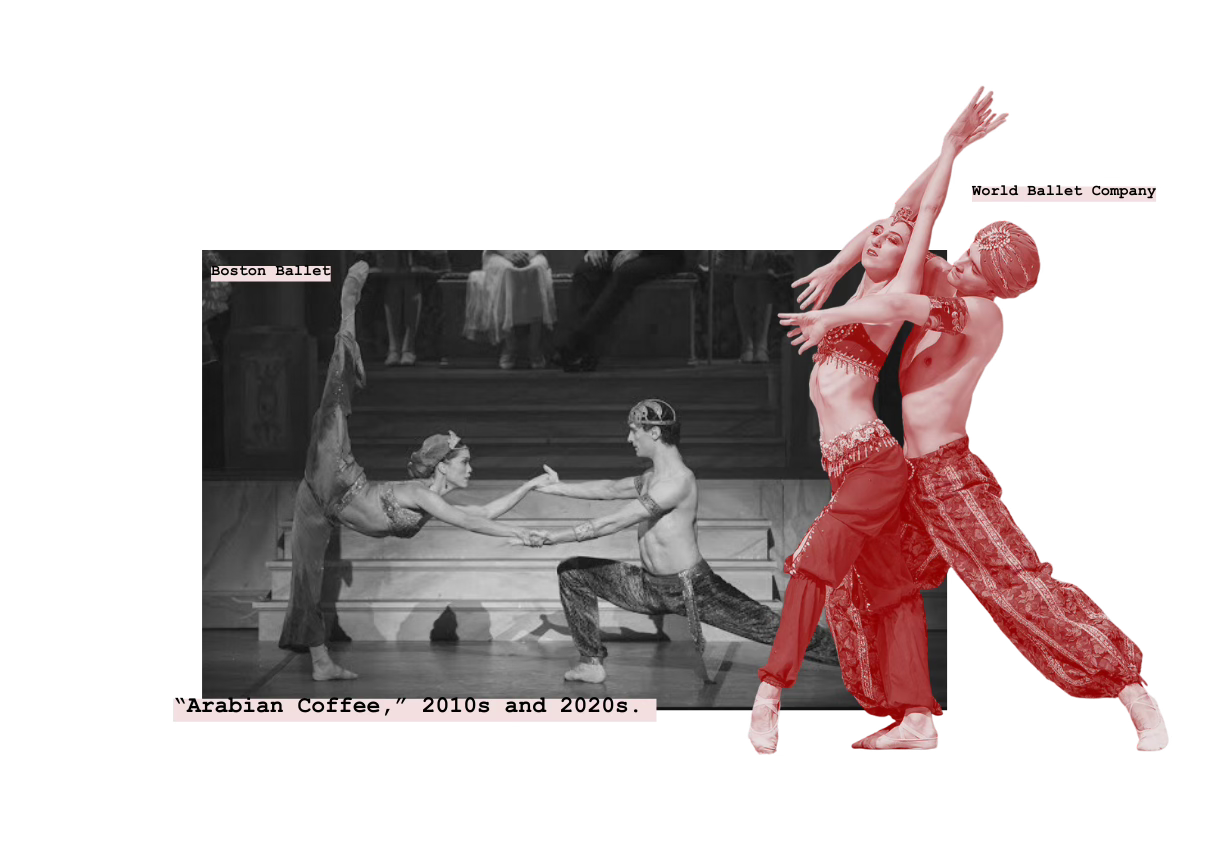
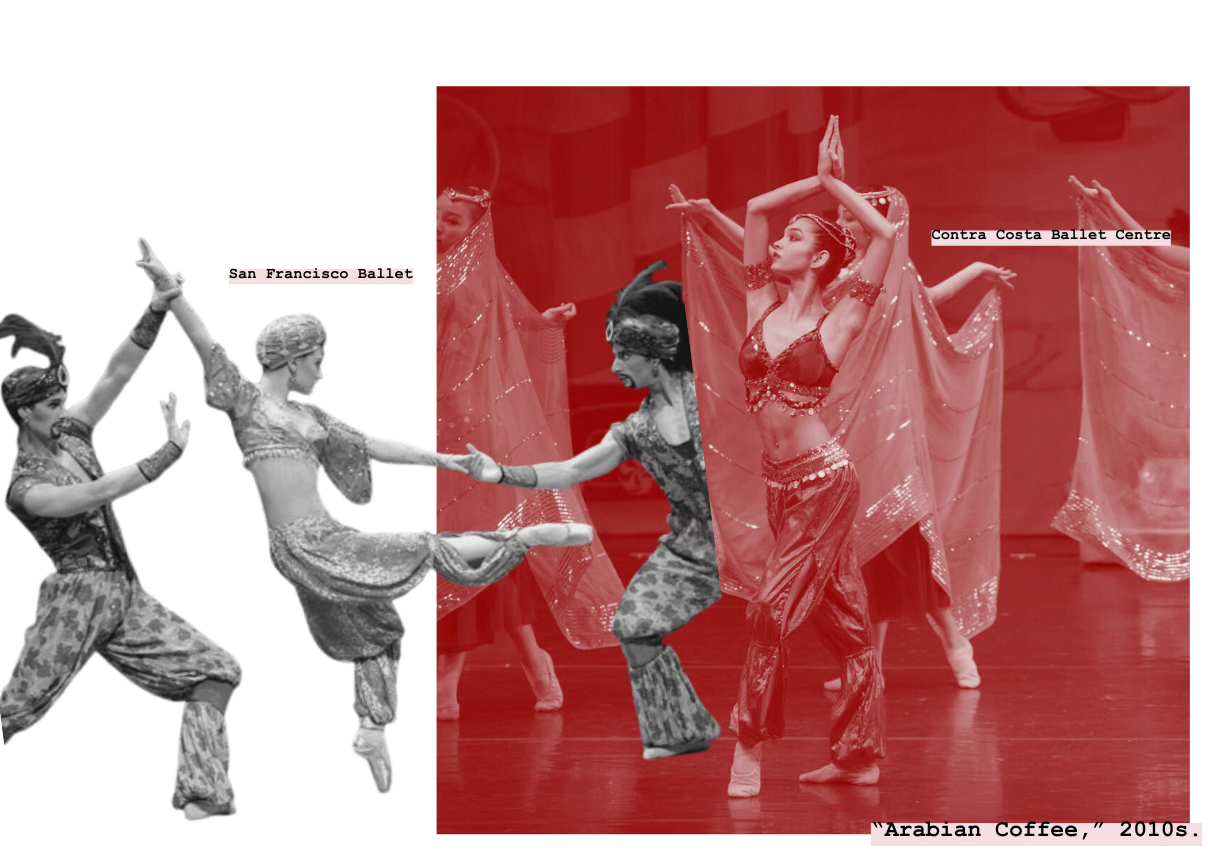
“Arabian Coffee” is the second piece in The Nutcracker’s divertissements. The “mysterious,” “sensual” music is a tonal departure from the jovial, sparkling energy of the Sugarplum Welcome and “Spanish Chocolate.”16 Sometimes, the piece is a solo. Sometimes, it’s a pas de deux, with movements and staging mimicking a snake and its charmer. And other times, it’s a group piece with a man at the center, meant to be a harem scene. No matter the casting choices, the combination of music, costuming, and choreography takes Arabian from sultry to fetishized. The Arabian Princess is typically given a bellydance or bellydance-adjacent costume, showing (as is customary) her bare torso and hips. She is hyperflexible and mesmerizing in her movements, as she was at my December trip to the Joffrey Ballet. Her legs spread again and again in jazz renverses, she drops into the splits on the marley floor—very uncommon in classical ballet—and in the Wheeldon version, the deux simulate raunchy sex, after which the male dancer drags the Princess across the floor.
While visually beautiful, even dancers like Pazcoguin—who is not of Arab, South, or West Asian descent—knew the role to be icky. “The saying was, for Balanchine’s choreography: ‘Something for the dads in the audience.’ Which like, ew.”
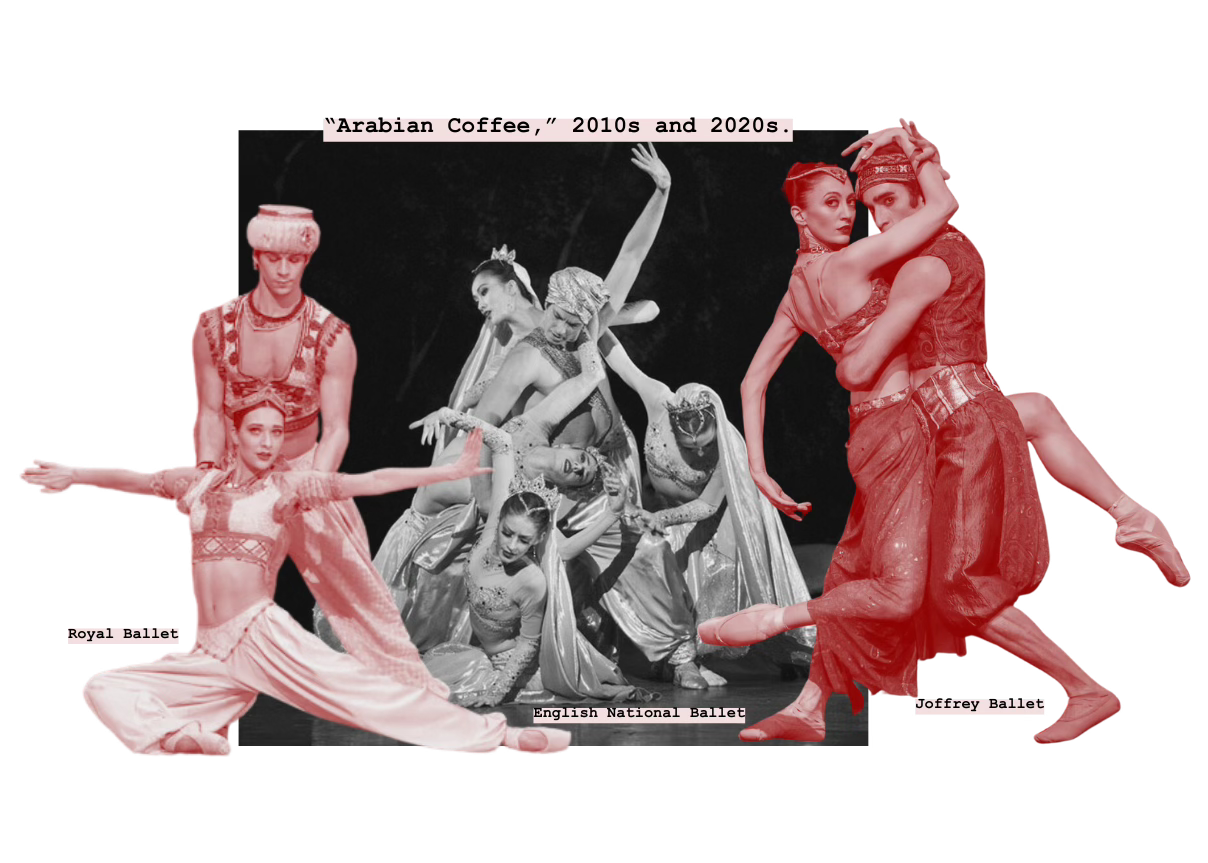
Despite the sexed-up choreography, the Arabian Princess is sometimes adorned in a head covering—usually a nod to a ghutra and adal, a hijab, or a shayla. Her male partner, when included in the divertissement, often wears a turban (whether he is meant to be Sikh, Sufi, a Sayyed, or a Kurd: we never know), fez, or a remix on a kufi. All of these head coverings have specific cultural, regional, and religious purposes, and none of them would be worn with a bellydance or shirtless costume.
To make matters worse, the choreography often includes one specific reference to Islamic head coverings: a common arm positioning in Arabian which Ghassemieh aptly named, “chador arms.”
“Walking on stage like [that] and only showing your eyes is just as bad as you [using pointed fingers] in Chinese for chopsticks,” she said.
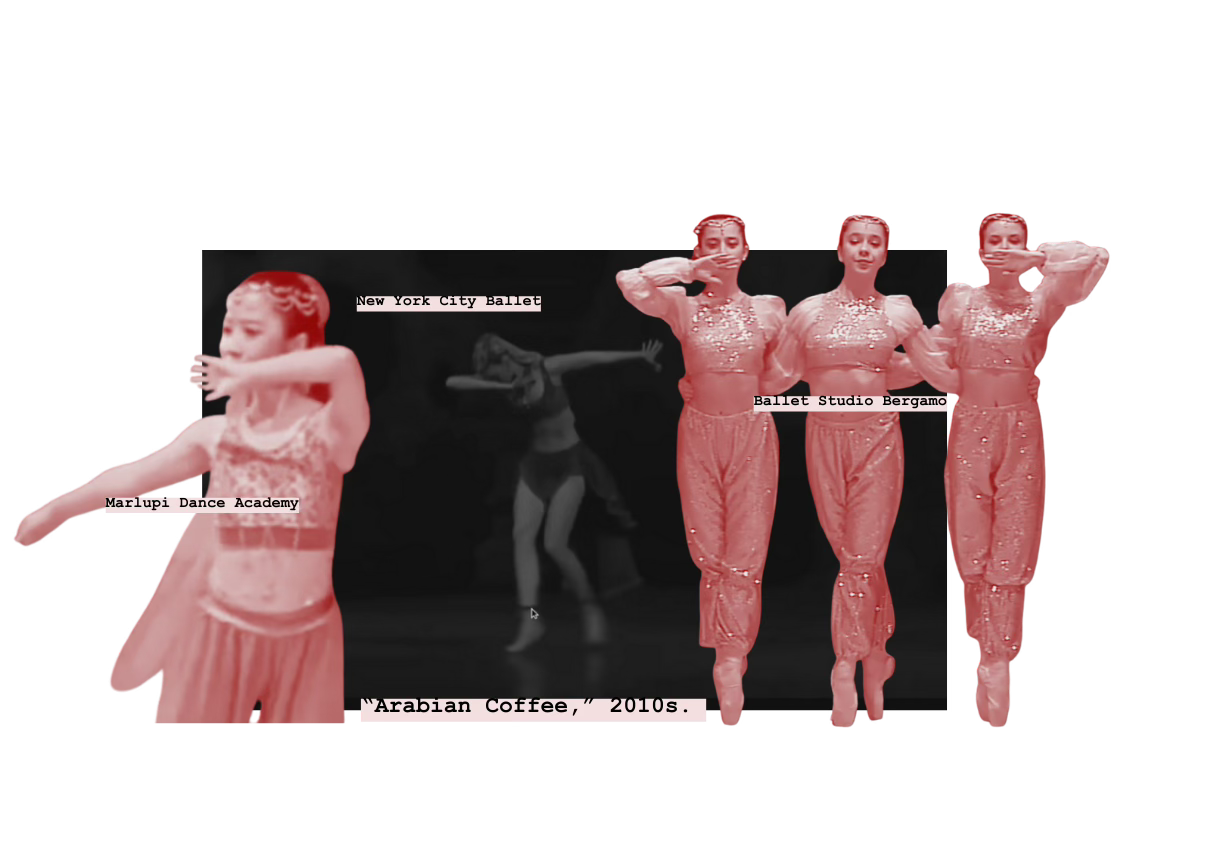
Chador imagery is highly sensitive for Iranian women, who have been forced by law to wear it for nearly 50 years. To emulate chador in a U.S. ballet production—especially while wearing a headscarf and baring one’s midriff—fetishizes the garment as much as it does disrespect it. “It’s racist to the woman who chooses to be Muslim, and wear the scarf on her head,” reminded Ghassemieh. “It’s racist to the sacred belly dancer who doesn’t wear the scarf, ‘cause she’s doing the sacred fertility dance. It’s just so bad!” Especially given the 2022 murder of Jina “Mahsa” Amini for “improper hijab,” the subsequent Woman Life Freedom movement, and the ongoing murders-by-regime of everyday Iranians protesting their government, there are real-life consequences to putting on (or taking off) a chador. As Ghassemieh said, “it’s a current issue that you are exploiting on the stage for children.”
While the cultures referenced in “Arabian Coffee” are very real, the actual land from which the Princess hails is more of an Agrabahi, Koorestani fantasy.17 Like Chinese Tea, Arabian is a false hodgepodge of Arab, Persian, Turkish, and South Asian cultures. The limbo in which the originators of The Nutcracker placed “Arabian” makes sense; in 1892, they had only stories to go off when creating this “Arabian” land. But if Scheherazade’s One Thousand and One Nights is any inspiration, then the centuries-long diaspora wars regarding whose story it really is would only add to their confusion.18
Regardless, Ghassemieh has empathy for the lack of accurate information in the time of The Nutcracker’s debut: “There’s no social media, there’s no way of really being educated [on other cultures in 1892]. So Tchaikovsky scores a sound that sounds ‘Middle Eastern,’ but did he get to use Middle Eastern instruments like a setar? No.” Ghassemieh also extends this nuance to the original choreographer, Petipa; “Petipa did the best he could with the education he had. But now, today, we know more. So we need to be brave enough to change it.”
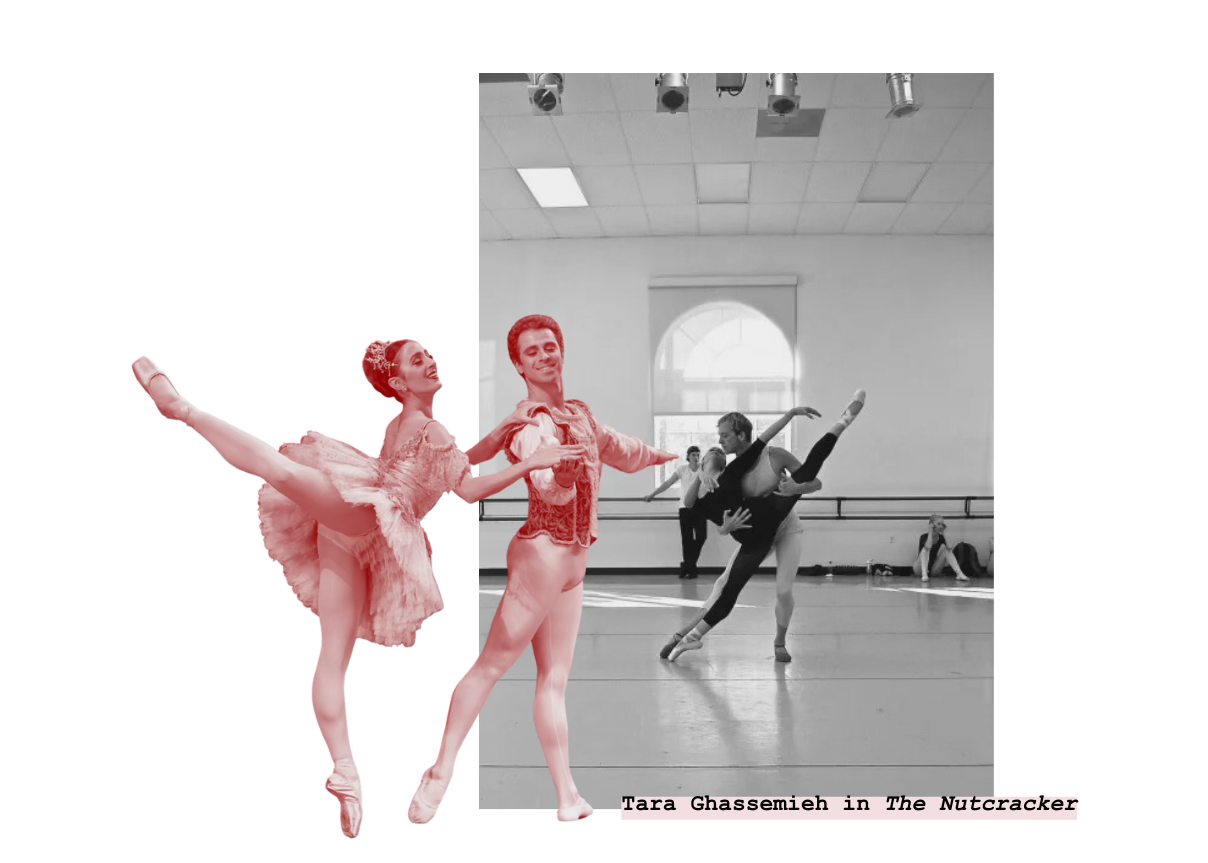
Making such changes, though, will require nailing down what “Arabian Coffee” exactly is. It’s proven a difficult feat to all who attempt, including those familiar with the region like Ghassemieh. “The reason it was [called] ‘Coffee’ is because, even at that time, Turkish coffee was the most famous,” she told me. But the divertissement is never a traditional Turkish dance—if it were, perhaps we’d see references to whirling dervishes or spoon dance. Instead, Coffee’s staging choices move it from country to country, culture to culture, era to era without warning. In one moment, the Princess’ palms point toward the sky, as would a Bharatanatyam or Kuchipudi dancer in South India. The next, she flips her wrists to the stage and moves slinkily along the floor, emulating Lebanese bellydance technique and Levantine tradition. She may move stoically in one moment, perhaps imitating Egyptian hieroglyphics, then switches into a rattlesnake’s fluidity—assumedly becoming, yes, a snake. And while she may wear the bellydance costume, she never assumes the true role of the sacred bellydancer; the Arabian Princess, typically White, rarely moves her square hips.19
In fact, the “Arabian Princess” bastardizes the original purpose of bellydance: a sacred fertility practice between women, where ululations fly as a young women shakes what her mama gave her for the first time—surrounded by supportive community. “If you’re gonna wear the sacred costume of the bellydancer, you better be bellydancing,” said Ghassemieh. “Do not do a oversexualized adagio in a bellydancer costume and pointe shoes.”
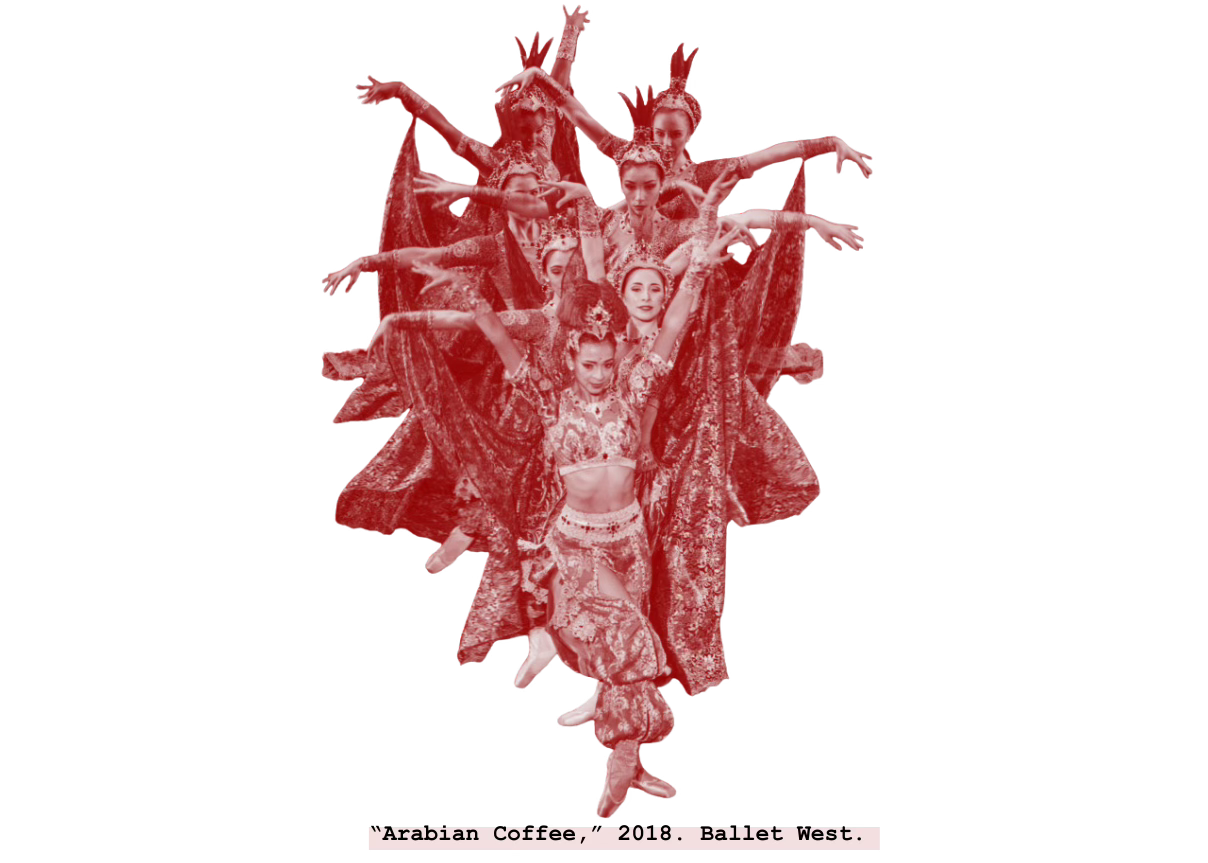
But rather than do away with the not-really-Arab “Arabian Coffee,” Ghassemieh hopes to be part of making the divertissement right, and presenting a more accurate vision of the South and West Asian regions. After all, she understands how important a special role like Arabian Princess is for ballet dancers—especially those who actually have that background. She wants to do away with the fetishization and sexist, racist imagery, and introduce instead the real dance cultures from the region to “Arabian Coffee.”
“We’ve taken all this time to reimagine Russian and Spanish and Chinese,” she told me, referencing the work Georgina Pazcoguin and Phil Chan did with Final Bow for Yellowface. “What about us? Why are we the only ones left in the dust?”
A Nutcracker for 2026?
In the next installment, I’ll share what Ghassemieh and Pazcoguin have already done to move Nutcracker lovers from conversation to action. You’ll hear again from Phil Chan and Jennifer Lin of ABOUT FACE (2024), get updates on the Final Bow for Yellowface campaign, and see what Ghassemieh has cooked up to fight anti-Arab and anti-SWANA racism in the ballet world. And, best of all, you’ll get to read the Dream Nutcracker that we’ve cooked up together: one where Brown and Black people, mixed families, and loud-and-proud immigrants are given the dreamy, holiday show we deserve.
Until then, explore the links below to dive deeper into the movement to change The Nutcracker, and ballet at large:
Request a Screening of ABOUT FACE;
SOUTHSIDE CHICAGO PEOPLE STAY VERY TUNED <3
More soon, and merde out there.
William Christiensen of Brigham, Utah. Says a lot. Kind of a king, though. https://www.balletwest.org/company/americas-first-nutcracker
Every Nutcracker production is different: these were the names for my hometown Nutcracker, but my college Nutcracker had a totally different candy (Licorice, I think?) for what’s usually Russian. But by and large, most Nutcracker productions have their own reference to either the country or the sweets named above (or both). Remember: The whole story is a Yellow fever dream, anyway.
The Western world's often biased, stereotyped, and exoticizing perception, representation (in art, literature), and study of Eastern cultures, framing the "Orient" as inherently different, inferior, irrational, or sensual compared to the West, often to justify colonial power and reinforce European identity. S/O my guy, Edward Said.
If you’ve seen Tiny Pretty Things, Dance Academy, Flesh and Bone, even Black Swan... Most dark ballet dramas are based on the competitiveness of these very boarding schools.
A nickname for the specific finger choreography used in many versions of The Nutcracker, where Chinese dancers perform ballet choreography with their lower body, but hold their arms in a cactus pose, with one finger on each hand pointing toward the sky. Ballet scholars and experts like Pazcoguin believe this choreography is meant to either emulate chopsticks, or 19th century porcelain figures (What is porcelain also called? China). Either way: whack.
“Any Nutcracker aficionado will recognize it as ‘Chinese,’ but as a dance scholar, I can tell you the gesture does not exist in any version of traditional dance in China…The finger-pointing is mostly an example of heedless insensitivity to stereotyping.” Jennifer Fisher, Nutcracker Nation.
Sinophobia refers to the fear, intense dislike, or hatred of China, its people, or its culture. It manifests as prejudice and discrimination directed toward Chinese individuals and, by extension, other East and Southeast Asian communities, often fueled by geopolitical tensions, racism, and stereotypes.
Persian and Iranian are not the same thing! Persian is the ethnicity that Ghassemieh and I share, while Iran (currently the IRI) is the country from which both our families hail. I will be using these terms in specific ethnic and national contexts throughout this piece. You can be Iranian and Persian, but you can also be Iranian without being Persian. Persian supremacy is Iran has caused much strife for our Kurdish, Azeri, Afghan, Mizrahi, and other brothers and sisters in the country, and exiled Iranian Persians tend to refer to themselves as “Persian” > “Iranian,” as the former is considered “less scary.” That’s supremacist thinking, very weird, and has incited lots of uncomfortable conversations and interactions for Iranians everywhere. Iran has not been called Persia since 1935—an actually good move to reflect the country’s ethnic diversity. To my fellow Persians: Get over it!!!!
Source: It came to me in a dream. But I’m serious here: Iranian women know things. Ghassemieh and I are both California girls, so it’s possible that this is a woo-woo moment. But I swear: I’d trust any Iranian girlie’s dream/vision/download whenever I hear it. My mom’s dreams are just way too accurate.
A chador is a robe and head covering which covers almost the entire body, and is most used in Iran, as it is legally required in public after the Islamic Revolution. It is a distinct garment from a niqab or a burka. Nowadays, thanks to the dangerous and often lethal organizing work throughout the 21st century, more Iranian women are able to appear in public without chador. That, however, is not the case everywhere in Iran. Also: chador imagery is often used by the West to represent the “threat of Islam” to Western, “secular” societies, as Iran briefly attempted to be before 1979.
To be clear: Every Muslim’s relationship to music is different, because Islam is not a monolith. This point is not a commentary on Islamic guidance re: music to individual people of faith—I believe that everyone deserves to have their own deen. In this case, though, the IRI forces all Iranians (regardless of their faith or cultural practices) to follow their definition of deen. A free Iran, by my read, is one where every religious practice is welcome: including Sunnis, Sufis, and Shias, as well as Zoroastrians, Jews, Christians, and every other practice under the sun. Wouldn’t that be lovely?
I almost used Ayatollah here, as that’s Khameini’s Iranian and Islamic title. But honestly, it made me sad to even use it. Considering Sufism and Shiism’s relationship with dance, and song, and the movement of the body, it makes me sad that Khameini distorts it to hurt the people who keep Iranian culture, regardless of religion, alive: those who sing, dance, and move as an expression of the Divine. (Yes, especially women!)
This is not unique to Persian or Iranian culture, though! While my mom, aunt, and grandma are my personal gher pioneers, I worked out my gher more than I ever have on a boat in Istanbul this past summer. My Turkish girlies know how to move!
Listen: I’m Italian. I’ve drank enough Chianti to swear off it for life. Lambrusco tastes like heaven and Emilia-Romagnia is one of the most beautiful places in the world to grow grapes. But the Romans did not invent wine—there is archaeological record of wine being produced in the Caucasus region (ancient Georgia, Armenia, Iran) since 6000 BCE, and ancient Iran is one of the first documented societies to produce wine regularly (4000 BCE). Try a sweet Shiraz and you’ll see who the master winemakers are.
Tara herself got me back in the ballet studio this year. Thanks, girl. Petit allegro hurts so good.
Not to be random, but I choreographed the Spanish divertissement in my college Nutcracker. Apparently, in 2017, no one had ever considered actually incorporating Spanish (or any Latin) ballroom dance into the choreography. I trained briefly in paso doble and flamenco in my international Latin ballroom classes throughout middle and high school, and while I am far better in samba and cha cha, my reasonable knowledge led to the Spanish dance being... actually... Spanish. Not just ballet with “Flamenco-y arms.” These dance styles have histories and technique, and are so much better to watch when sprinkled with even a bit of authenticity! Wouldn’t it be cool if Nutcracker actually did them justice?
I love Princess Jasmine and I love Fran Fine (most of the time). I just think it’s freak shit to make up a country, then make it SO OBVIOUS what nation or ethnic groups you are talking about anyway. JUST MAKE THE FUCKING PLAY ABOUT US AT THAT POINT.
It’s Persian. Don’t start with me.
They don’t keep you around in the professional ballet world if you have a booty.
It’s also so interesting to me that the Joffrey did an almost complete overhaul of their Nutcracker and kept in so many of the racist parts? Just because it’s recontextualized in the (racist) world’s fair doesn’t make the Arabian Coffee dance less racist?
this was such an interesting deep dive! although i've never seen the nutcracker, i've had a vague idea of its history, but didn't know how deep its racism went. i look forward to the next part!
ヾ(•ω•`)o